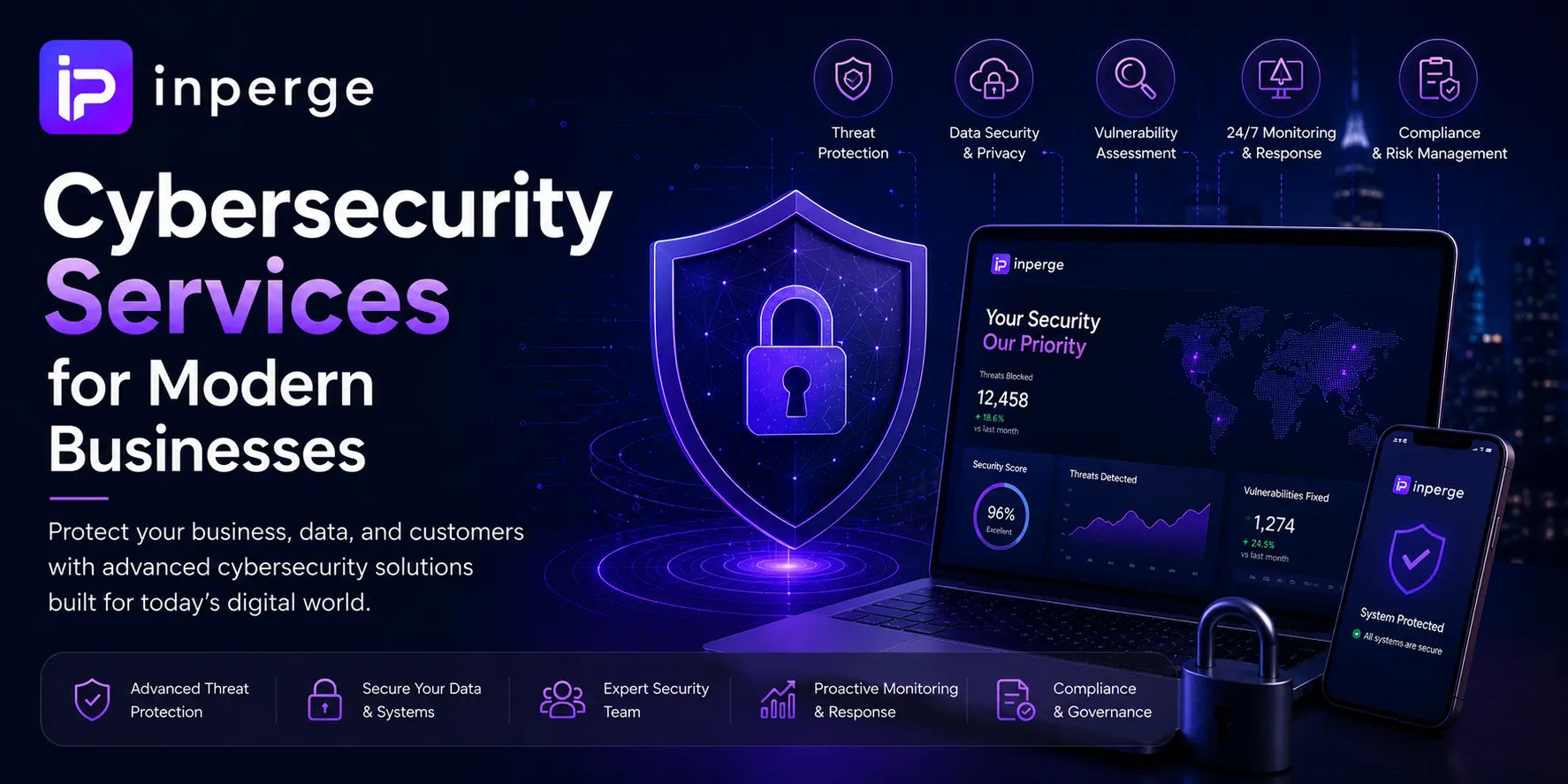
Cybersecurity Services for Modern Businesses
From penetration testing to cloud and application security — a practical guide to protecting data, ensuring compliance, and building business resilience.
Inperge Security
Cybersecurity Team
- What Are Cybersecurity Services?
- Why Cybersecurity Is Essential for Businesses
- Rising Cyber Threats
- Protecting Sensitive Data
- Maintaining Customer Trust
- Key Benefits of Cybersecurity Services
- Improved Risk Management
- Business Continuity
- Regulatory Compliance
- Enhanced Security Awareness
- Understanding Vulnerability Assessments and Penetration Testing
- Vulnerability Assessment
- Penetration Testing
- Application Security in Modern Software Development
- Cloud Security for Modern Organizations
- Common Cybersecurity Challenges Businesses Face
- Increasing Attack Complexity
- Limited Security Resources
- Rapid Technology Adoption
- Compliance Requirements
- Cybersecurity Trends in 2026
- AI-Powered Threat Detection
- Zero Trust Security
- Cloud-Native Security
- Security Automation
- Advanced Threat Intelligence
- How Cybersecurity Supports Business Growth
- Enables Digital Transformation
- Improves Customer Confidence
- Reduces Financial Risk
- Supports Competitive Advantage
- Choosing the Right Cybersecurity Company
- Conclusion
As businesses become increasingly dependent on digital technologies, cybersecurity has evolved from an IT concern into a critical business priority. Organizations today manage vast amounts of sensitive information, including customer data, financial records, intellectual property, and operational systems. At the same time, cyber threats continue to grow in frequency and sophistication.
From ransomware attacks and phishing scams to data breaches and application vulnerabilities, businesses face significant security risks that can disrupt operations and damage reputation. This is why organizations across industries are investing in professional cybersecurity services to strengthen their defenses and protect critical assets.
A proactive cybersecurity strategy not only reduces risk but also helps businesses maintain customer trust, comply with regulations, and support long-term growth.
What Are Cybersecurity Services?
Cybersecurity services help businesses identify, prevent, detect, and respond to cyber threats that target their systems, applications, and data. These services are designed to create a secure digital environment while minimizing the risk of security incidents.
Common cybersecurity services include:
- Vulnerability Assessment
- Penetration Testing
- Security Audits
- Application Security Testing
- Cloud Security
- Network Security
- Security Monitoring
- Incident Response
- Compliance Assessments
- Risk Management
By implementing comprehensive security measures, businesses can better protect themselves from evolving cyber threats.
Why Cybersecurity Is Essential for Businesses
Cyberattacks are no longer limited to large corporations. Small and medium-sized businesses are increasingly becoming targets because attackers often view them as easier targets.
Rising Cyber Threats
Modern cybercriminals use advanced techniques to exploit vulnerabilities in systems and applications. Common threats include:
- Ransomware attacks
- Phishing campaigns
- Malware infections
- Data breaches
- Insider threats
- Credential theft
Without adequate protection, businesses may face severe financial and operational consequences.
Protecting Sensitive Data
Businesses collect and store valuable information such as customer records, financial data, employee information, and proprietary business data. Cybersecurity services help ensure that sensitive information remains protected from unauthorized access.
Maintaining Customer Trust
Customers expect businesses to handle their information securely. A security breach can result in loss of customer confidence, negative publicity, legal consequences, and reduced revenue. Strong cybersecurity practices help preserve trust and brand reputation.
Key Benefits of Cybersecurity Services
Improved Risk Management
Cybersecurity professionals assess potential vulnerabilities and recommend strategies to reduce risk. This proactive approach helps organizations address security gaps before they can be exploited.
Business Continuity
Cyberattacks can disrupt critical operations and lead to costly downtime. Effective cybersecurity measures help ensure business continuity by minimizing disruptions and enabling rapid recovery.
Regulatory Compliance
Many industries must comply with security and privacy regulations. Cybersecurity services help businesses meet compliance requirements and avoid penalties.
Enhanced Security Awareness
Human error remains one of the leading causes of security incidents. Security programs often include employee awareness initiatives that help staff recognize and respond to potential threats.
Understanding Vulnerability Assessments and Penetration Testing
One of the most effective ways to improve security is through regular testing and assessments.
Vulnerability Assessment
A vulnerability assessment identifies weaknesses within systems, applications, and networks. The process helps organizations discover security gaps, prioritize risks, and improve security controls.
Penetration Testing
Penetration testing simulates real-world cyberattacks to evaluate security effectiveness. Benefits include identifying exploitable vulnerabilities, testing security defenses, and improving incident preparedness. Together, vulnerability assessments and penetration testing provide valuable insights into an organization's security posture.
Application Security in Modern Software Development
Applications are often targeted by attackers because they provide direct access to business systems and data. Application security focuses on identifying and mitigating vulnerabilities throughout the software development lifecycle. Important security practices include:
- Secure coding standards
- Code reviews
- Security testing
- API security assessments
- Dependency management
Integrating security into development processes helps reduce risk and improve software quality.
Cloud Security for Modern Organizations
As businesses migrate applications and data to cloud environments, cloud security has become increasingly important. Cloud security services help organizations protect cloud infrastructure, data storage, user identities, workloads, and APIs.
Effective cloud security strategies include:
- Identity and access management
- Encryption
- Continuous monitoring
- Security configuration management
A secure cloud environment supports scalability without compromising protection.
Common Cybersecurity Challenges Businesses Face
Increasing Attack Complexity
Cybercriminals continuously develop new techniques to bypass traditional security controls.
Limited Security Resources
Many organizations lack dedicated cybersecurity teams or expertise.
Rapid Technology Adoption
The adoption of cloud platforms, mobile applications, and connected devices introduces new security risks.
Compliance Requirements
Managing multiple security regulations can be complex and time-consuming. Professional cybersecurity services help businesses address these challenges more effectively.
Cybersecurity Trends in 2026
AI-Powered Threat Detection
Artificial Intelligence is helping organizations identify and respond to threats faster than traditional methods.
Zero Trust Security
Businesses are increasingly adopting Zero Trust frameworks that verify every user and device before granting access.
Cloud-Native Security
Security solutions are evolving to protect modern cloud environments and distributed infrastructures.
Security Automation
Automation is helping organizations improve incident response and reduce manual workloads.
Advanced Threat Intelligence
Businesses are leveraging threat intelligence to anticipate and prepare for emerging cyber risks.
How Cybersecurity Supports Business Growth
Cybersecurity is often viewed as a protective measure, but it also supports growth and innovation.
Enables Digital Transformation
Secure systems allow organizations to adopt new technologies with confidence.
Improves Customer Confidence
Strong security practices reassure customers and strengthen brand reputation.
Reduces Financial Risk
Preventing security incidents helps avoid costly disruptions, fines, and recovery expenses.
Supports Competitive Advantage
Organizations with mature security programs often gain an advantage when competing for customers and business partnerships.
Choosing the Right Cybersecurity Company
Businesses seeking stronger protection against cyber threats should work with experienced cybersecurity professionals. Before selecting a provider, organizations should assess:
- Security certifications
- Technical expertise
- Service offerings
- Industry experience
- Incident response capabilities
- Client success stories
A trusted cybersecurity partner brings security expertise across vulnerability assessments, penetration testing, cloud security, and application security; industry knowledge of relevant regulations; a proactive focus on prevention, continuous monitoring, and risk management; and ongoing support for long-term protection.
Conclusion
Cyber threats continue to evolve, making cybersecurity a fundamental requirement for modern businesses. Organizations must take proactive steps to protect sensitive data, secure digital assets, and maintain customer trust. Professional cybersecurity services provide the expertise, tools, and strategies needed to identify vulnerabilities, prevent attacks, and respond effectively to security incidents. From application security and cloud protection to penetration testing and compliance support, cybersecurity plays a critical role in business resilience and long-term success. As digital transformation accelerates, businesses that prioritize cybersecurity will be better positioned to innovate, grow, and operate securely in an increasingly connected world.
Building something like this?
Our team turns ideas into shipped software. Tell us about your project and we'll map out the path.
Start a conversation