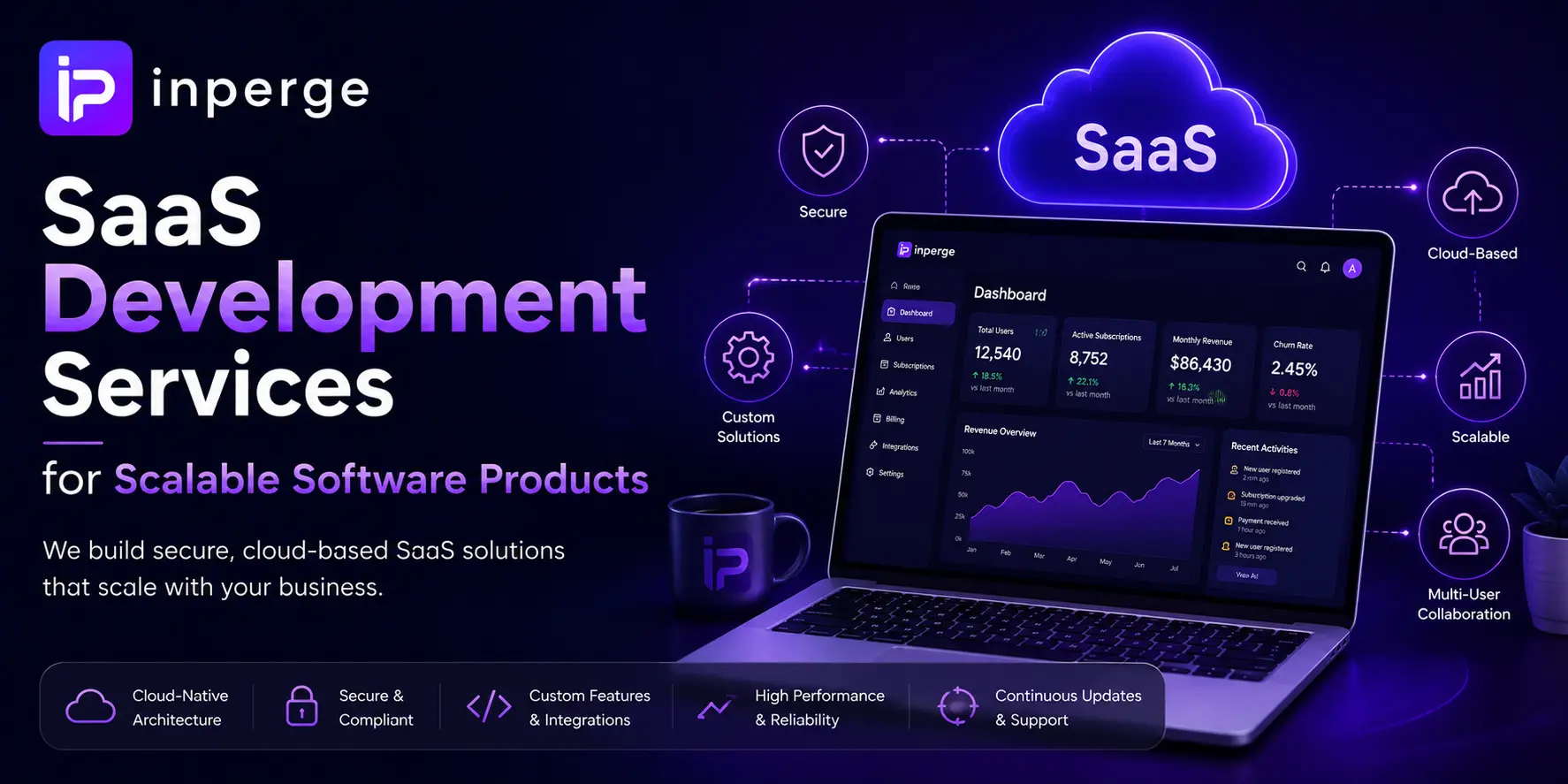
SaaS Development Services for Scalable Software Products
Building secure, scalable, subscription-based software products — the services, architecture, and trends behind successful SaaS platforms.
Inperge Product Team
SaaS Engineering
- What Are SaaS Development Services?
- Why SaaS Products Are Growing Rapidly
- Global Accessibility
- Subscription-Based Revenue
- Lower Infrastructure Costs
- Key Benefits of SaaS Development Services
- Scalability
- Faster Deployment
- Improved Customer Experience
- Data-Driven Insights
- Essential Features of a Successful SaaS Platform
- Multi-Tenant Architecture
- Secure User Authentication
- Subscription and Billing Management
- API Integrations
- Industries Benefiting from SaaS Solutions
- Healthcare
- Finance
- Education
- Retail and E-Commerce
- SaaS Development Trends in 2026
- AI-Powered SaaS Applications
- Vertical SaaS
- Low-Code Integration
- Enhanced Security and Compliance
- How SaaS Development Supports Business Growth
- Recurring Revenue
- Global Market Reach
- Customer Retention
- Competitive Advantage
- Choosing the Right SaaS Development Company
- Conclusion
Software as a Service (SaaS) has transformed how businesses develop, deliver, and consume software. Instead of installing software on local systems, users can access cloud-based applications through a web browser from anywhere in the world. This model has become increasingly popular because it offers flexibility, scalability, and cost efficiency for both businesses and customers.
Today, companies across industries are investing in SaaS products to create recurring revenue streams, improve customer accessibility, and accelerate digital transformation. From project management tools and CRM platforms to healthcare systems and financial applications, SaaS solutions are powering modern businesses worldwide.
As demand continues to grow, professional SaaS development services have become essential for organizations looking to build secure, scalable, and high-performing software products.
What Are SaaS Development Services?
SaaS development services involve designing, developing, deploying, and maintaining cloud-based software applications that users can access online through a subscription model.
These services typically include:
- SaaS Product Strategy
- SaaS Application Development
- UI/UX Design
- Multi-Tenant Architecture Development
- API Development and Integration
- Cloud Infrastructure Setup
- SaaS Security Implementation
- Subscription Billing Integration
- Performance Optimization
- Ongoing Maintenance and Support
A SaaS development company helps businesses transform ideas into fully functional cloud-based software platforms.
Why SaaS Products Are Growing Rapidly
The SaaS business model offers significant advantages compared to traditional software distribution.
Global Accessibility
Users can access SaaS applications from any location with an internet connection. This flexibility supports remote work, global customer acquisition, multi-location operations, and improved collaboration.
Subscription-Based Revenue
Unlike one-time software purchases, SaaS products generate recurring monthly or annual revenue. This creates predictable cash flow, better customer retention, and long-term business stability.
Lower Infrastructure Costs
Cloud-based delivery reduces hardware and maintenance requirements for customers. Businesses can focus on delivering value without requiring users to manage complex installations.
Key Benefits of SaaS Development Services
Scalability
One of the biggest advantages of SaaS applications is scalability. As user demand grows, businesses can easily expand storage capacity, computing resources, application features, and user accounts. This flexibility supports long-term growth without major system redesigns.
Faster Deployment
SaaS products can be updated and deployed quickly. Businesses can release new features, security updates, and performance improvements without requiring users to manually install software updates.
Improved Customer Experience
Modern SaaS platforms provide intuitive interfaces, cross-device accessibility, real-time collaboration, and personalized experiences. A better user experience contributes to higher customer satisfaction and retention.
Data-Driven Insights
SaaS applications often include analytics and reporting capabilities. Businesses can gain insights into user behavior, product performance, customer engagement, and revenue trends. These insights support continuous improvement and growth.
Essential Features of a Successful SaaS Platform
Multi-Tenant Architecture
Multi-tenancy allows multiple customers to use a single application while keeping their data isolated and secure. Benefits include lower operational costs, simplified maintenance, and efficient resource utilization.
Secure User Authentication
Security is critical for SaaS applications. Features often include multi-factor authentication, role-based access control, Single Sign-On (SSO), and data encryption.
Subscription and Billing Management
A successful SaaS product requires seamless subscription handling. Capabilities may include monthly and annual plans, automated billing, payment gateway integration, and invoice generation.
API Integrations
Modern SaaS products often integrate with third-party systems such as CRMs, accounting software, marketing platforms, and payment gateways. Integrations improve functionality and user experience.
Industries Benefiting from SaaS Solutions
Healthcare
Healthcare SaaS applications support telemedicine, electronic health records, appointment scheduling, and patient management.
Finance
Financial institutions use SaaS platforms for payment processing, compliance management, investment tracking, and financial reporting.
Education
Educational organizations leverage SaaS products for learning management systems, online classes, student portals, and assessment platforms.
Retail and E-Commerce
Retail businesses use SaaS solutions for inventory management, customer relationship management, analytics and reporting, and marketing automation.
SaaS Development Trends in 2026
AI-Powered SaaS Applications
Artificial Intelligence is becoming a major differentiator for SaaS products. Businesses are integrating AI chatbots, predictive analytics, automated workflows, and intelligent recommendations.
Vertical SaaS
Instead of targeting broad audiences, many companies are building industry-specific SaaS solutions. Examples include Healthcare SaaS, Legal SaaS, Real Estate SaaS, and Logistics SaaS.
Low-Code Integration
Businesses increasingly expect SaaS platforms to support workflow automation and low-code customization.
Enhanced Security and Compliance
As cybersecurity risks grow, SaaS providers are investing heavily in data protection, compliance management, identity verification, and threat monitoring.
How SaaS Development Supports Business Growth
A well-built SaaS platform can create sustainable growth opportunities. Benefits include:
Recurring Revenue
Subscription-based pricing generates predictable income streams.
Global Market Reach
Cloud-based applications can serve customers worldwide.
Customer Retention
Continuous updates and ongoing value encourage long-term customer relationships.
Competitive Advantage
Custom SaaS products provide unique capabilities that differentiate businesses from competitors.
Choosing the Right SaaS Development Company
Selecting the right partner is critical for product success. Businesses should assess:
- Technical capabilities
- SaaS portfolio
- Industry expertise
- Scalability planning
- Communication processes
- Post-launch support
A reliable partner should also offer product development experience across industries, cloud expertise in environments such as AWS, Azure, and Google Cloud, security integrated into every stage of development, and long-term maintenance and feature enhancements.
Conclusion
The SaaS industry continues to grow rapidly as businesses seek flexible, cloud-based solutions that improve accessibility, scalability, and operational efficiency. Professional SaaS development services enable organizations to build secure, high-performing software products that generate recurring revenue and support long-term growth. From startups launching innovative platforms to enterprises modernizing legacy systems, SaaS development provides the foundation for digital success. As cloud adoption accelerates and customer expectations continue to evolve, investing in SaaS development can help businesses create sustainable competitive advantages and unlock new growth opportunities.
Building something like this?
Our team turns ideas into shipped software. Tell us about your project and we'll map out the path.
Start a conversation